
Spend time around a professional tea taster and you’ll notice they use a surprisingly small, precise set of words again and again: bright, brisk, body, malty, coppery. These are not vague poetic flourishes. In the tea trade they are a working vocabulary, developed over more than a century of professional cupping, that lets a taster in Colombo describe a liquor to a buyer in London with real accuracy and no ambiguity. Learning even a handful of these words changes the way you drink tea, because it gives you something specific to look for in the cup rather than a vague sense of “good” or “not as good.”
How professional tasting actually works
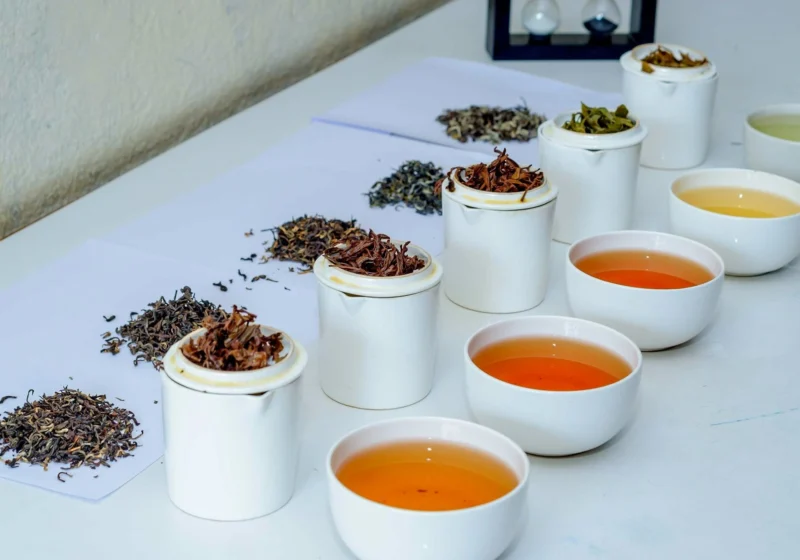
At a tasting table, a taster works through dozens or sometimes hundreds of samples a day, brewed to a strict standard: a fixed weight of leaf, boiling water, and a timed steep, usually five or six minutes, so that every sample is judged on equal terms. The taster looks at the dry leaf, smells the infused leaf after brewing, looks at the colour and clarity of the liquor, and finally tastes it, often slurping it loudly across the tongue to spread it over as many taste receptors as possible before spitting rather than swallowing. Across dozens of samples, swallowing would both affect judgement and simply not be practical.
This standardised approach matters enormously for fairness. If one sample were brewed for three minutes and another for seven, the comparison would be meaningless, since steeping time alone changes colour, body and astringency dramatically. By fixing every variable except the tea itself, professional cupping isolates exactly what the taster is supposed to be judging: the character of the leaf, not the choices made while brewing it. This is also why the vocabulary itself needs to be so precise. A taster’s written notes travel to buyers who never see the sample in person, so vague language simply would not do the job.
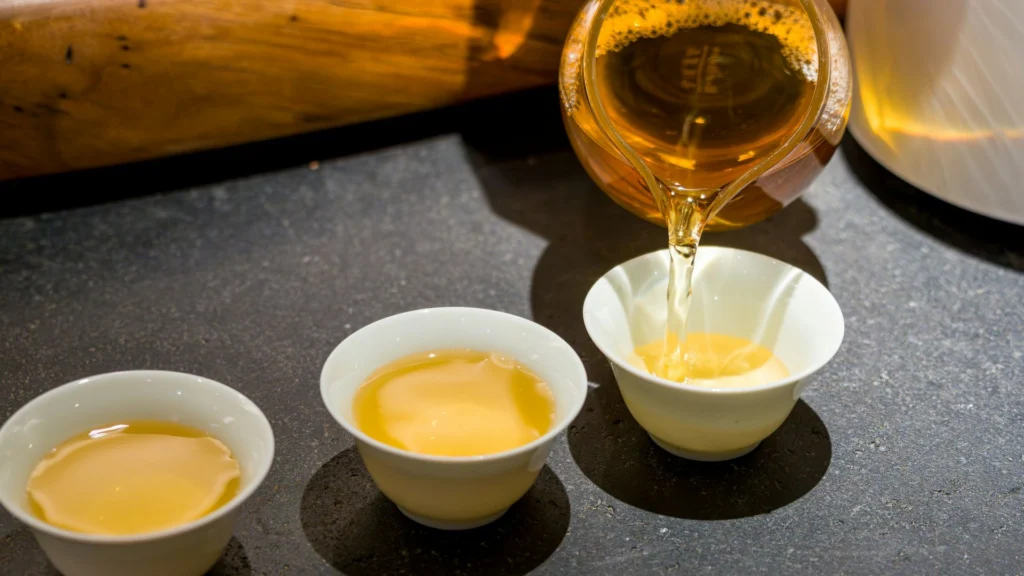
The physical setup is simple but deliberate: small, white porcelain bowls or cups, chosen because white shows liquor colour accurately, arranged in a row under good, consistent light, usually daylight or a daylight-balanced lamp, since colour judgements shift under warm artificial light. The infused leaf is often tipped onto the upturned lid of the brewing vessel and examined there, both for colour, which should be bright and even, and for any unevenness that might hint at problems during withering or oxidation.
Words for the liquor in the cup
- Bright — a lively, clear liquor with a certain sparkle to it, the opposite of dull or flat. Bright tea usually has a high proportion of theaflavins, the compounds formed early in oxidation.
- Brisk — a pleasant, refreshing bite on the tongue, almost a light tingle. This is a desirable kind of astringency, different from harsh bitterness.
- Body — how full, thick and substantial the tea feels in the mouth, independent of how strong or dark it looks.
- Strength — the intensity of flavour the tea delivers, which is not the same thing as colour; a pale tea can still taste strong.
- Malty — a warm, rounded flavour reminiscent of malted grain, often found in fuller-bodied Kandyan-style teas.
- Coppery — the bright reddish-orange colour of a well-made black tea liquor and its infused leaf, considered a sign of good oxidation.
- Flat — lacking briskness entirely; a sign of over-steeping, stale tea, or water that has been reboiled.
Words for the dry and infused leaf
- Tips — the golden or silvery young buds visible in some grades, which add sweetness and are often a sign of careful, fine plucking.
- Wiry — long, thin, tightly twisted leaf, typical of a well-rolled whole-leaf grade.
- Even — leaf particles of consistent size, a sign of careful sorting and good factory discipline.
- Infusion — the wet, spent leaf left in the strainer after brewing, which tasters examine for colour and evenness as a final check on how well the tea was made.
Why this vocabulary exists at all
The language developed because the tea trade needed a way to compare a huge number of different lots quickly and consistently, often with real money riding on the comparison at auction. A buyer thousands of kilometres away cannot taste the tea before bidding on it; they rely on a taster’s notes, written in this shared vocabulary, to know roughly what they are buying. That same precision is useful at home. Instead of simply deciding you “liked” or “didn’t like” a cup, naming what you’re tasting, is it bright or dull, brisk or flat, light-bodied or full, gives you a vocabulary for comparing teas and for telling someone else exactly what you’re looking for next time.
Try this at home
Brew two different Ceylon teas side by side using the same water, the same amount of leaf and the same steeping time. Taste them one after the other and try to name, in your own words first, then with the vocabulary above, what actually differs between them. The comparison teaches you far more than tasting either one alone.
Why region shows up in the vocabulary too
Experienced tasters often go further than describing a single cup; they learn to recognise the character typical of a particular growing region, almost the way a wine taster might recognise a region’s typical profile. A high-grown Nuwara Eliya tea is often described as light, fragrant and delicate, almost floral. A Uva tea, especially from its best quality season, is prized for a distinctive pungency, that sharp, lively bite mentioned earlier. A mid-grown Kandy tea tends toward a fuller, rounder, more malty character. None of these regional words replace the core vocabulary above; they build on it, letting a taster say not just that a tea is bright and brisk, but that it is bright and brisk in the particular way typical of a specific hill country district.
A short glossary of less common terms
| Term | Meaning |
|---|---|
| Thin | Lacking body, often from under-leafing or a weaker growing season |
| Harsh | Overly astringent in an unpleasant way, often from over-steeping or very hot, hard water |
| Smooth | Low in harsh astringency, pleasant and easy to drink without milk |
| Pungent | A sharp, lively intensity, often used positively for high-grown teas like some Uva lots |
| Self-drinking | A tea considered good enough to drink on its own, without blending with other lots |
The role of a taster in setting price
At the Colombo tea auction, a tea’s grade and estate name get it onto the catalogue, but it’s the taster’s assessment, often summarised in just a few of these precise words, that heavily influences the price it fetches. A lot described as bright, brisk and well-made will typically attract stronger bidding than one described as flat or thin, even if both carry the same grade letters. This is one of the clearest demonstrations of why the vocabulary matters commercially: it isn’t decorative language, it’s the working basis on which real money changes hands, lot by lot, week after week.
Where the words come from
Much of this vocabulary has roots stretching back through the British and colonial-era tea trade of the nineteenth and early twentieth centuries, when auction houses in London and later Colombo needed shared, unambiguous language to describe lots that buyers often never saw in person before bidding. Many of the terms, bright, brisk, body, have stayed almost unchanged for well over a century, which is a reasonable sign that they describe something real and consistently useful about tea, rather than being a passing fashion in trade jargon. A handful of terms are more regional: “pungency” in particular is used with special fondness to describe the sharp, lively character of good high-grown Uva tea during its best season.
How these words map onto what’s happening chemically
It’s worth connecting a few of these descriptive terms back to the actual chemistry at work, because it makes the vocabulary stick far better than memorising definitions alone. Brightness and briskness are strongly associated with theaflavins, compounds formed early in oxidation that give black tea its lively red-orange tones and a pleasant bite. Body and maltiness lean more on thearubigins, the darker, larger compounds that accumulate as oxidation continues and that contribute weight and roundness rather than sharpness. A tea described as flat has often lost some of its theaflavin character, either through over-steeping, which shifts the balance toward harsher tannins, or through age, since these compounds continue to change slowly even after the tea has been packed and sold.
Taste it yourself
Brew a cup of Ceylon black tea and taste it slowly, the way a professional would, rather than drinking it quickly out of habit. Is the liquor bright or a little dull? Does it have a brisk bite, or does it feel flat? How much body does it have on the tongue? Once you start naming what you taste using even a few of these words, you’ll likely find you notice more in every cup afterwards, and you will never drink tea in quite the same half-attentive way again. The vocabulary is not reserved for professionals; it exists precisely so that anyone, with a little practice, can describe what’s actually in the cup rather than reaching for a vague “good” or “not for me.”