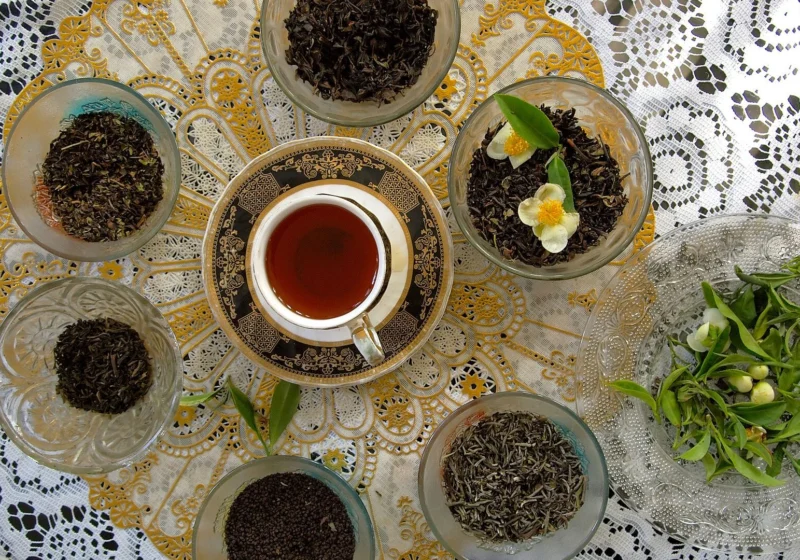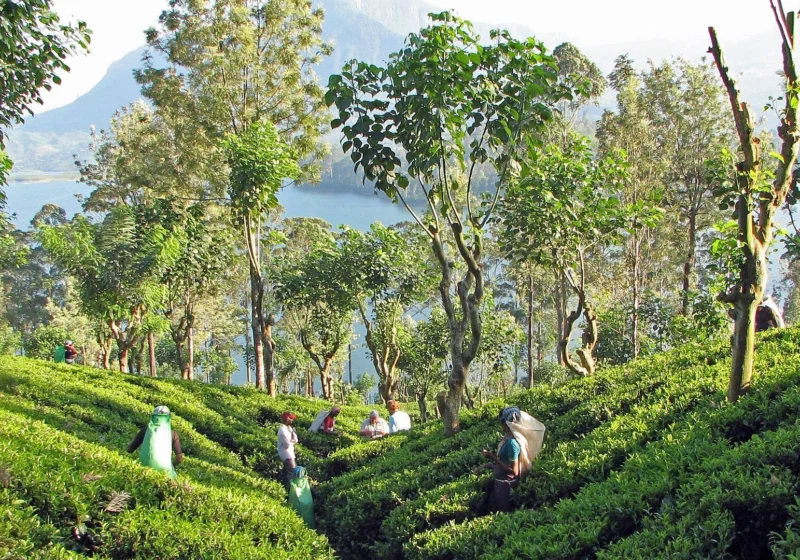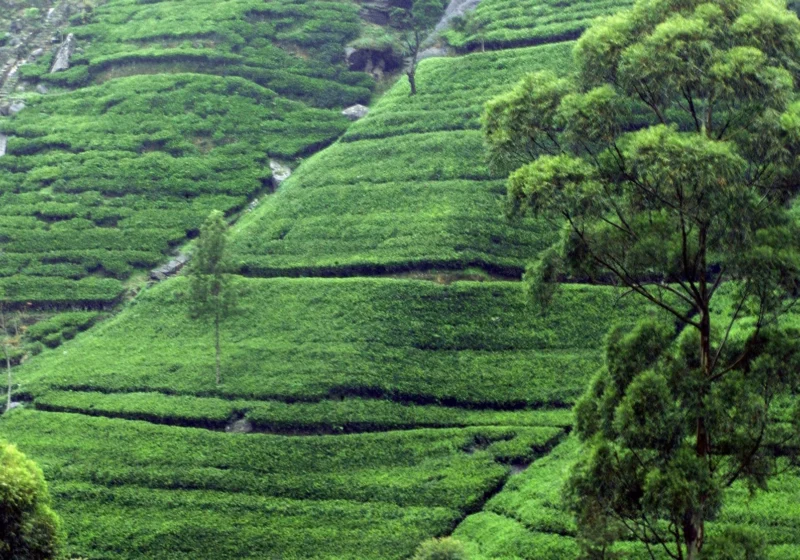

A tea factory in the hill country starts work the moment the first baskets of plucked leaf arrive from the field, and within roughly a day, soft, grassy-smelling green leaf has become the dark, fragrant black tea you’d recognise in a cup. The transformation happens in five distinct stages, and in an orthodox factory, the traditional method still used across most of Sri Lanka’s hill country, each stage is a judgement call as much as a mechanical process, shaped by the skill of the people running the floor that day.
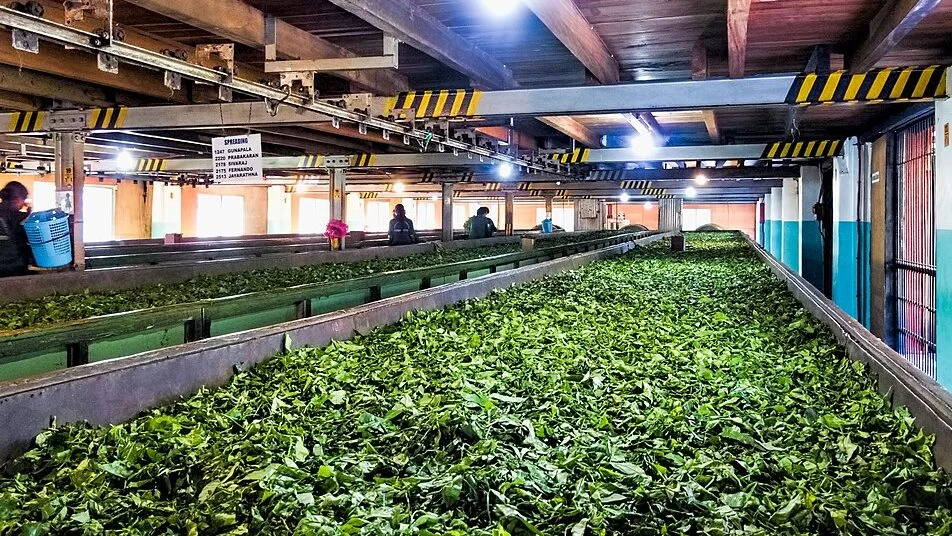
1. Withering: taking out the water
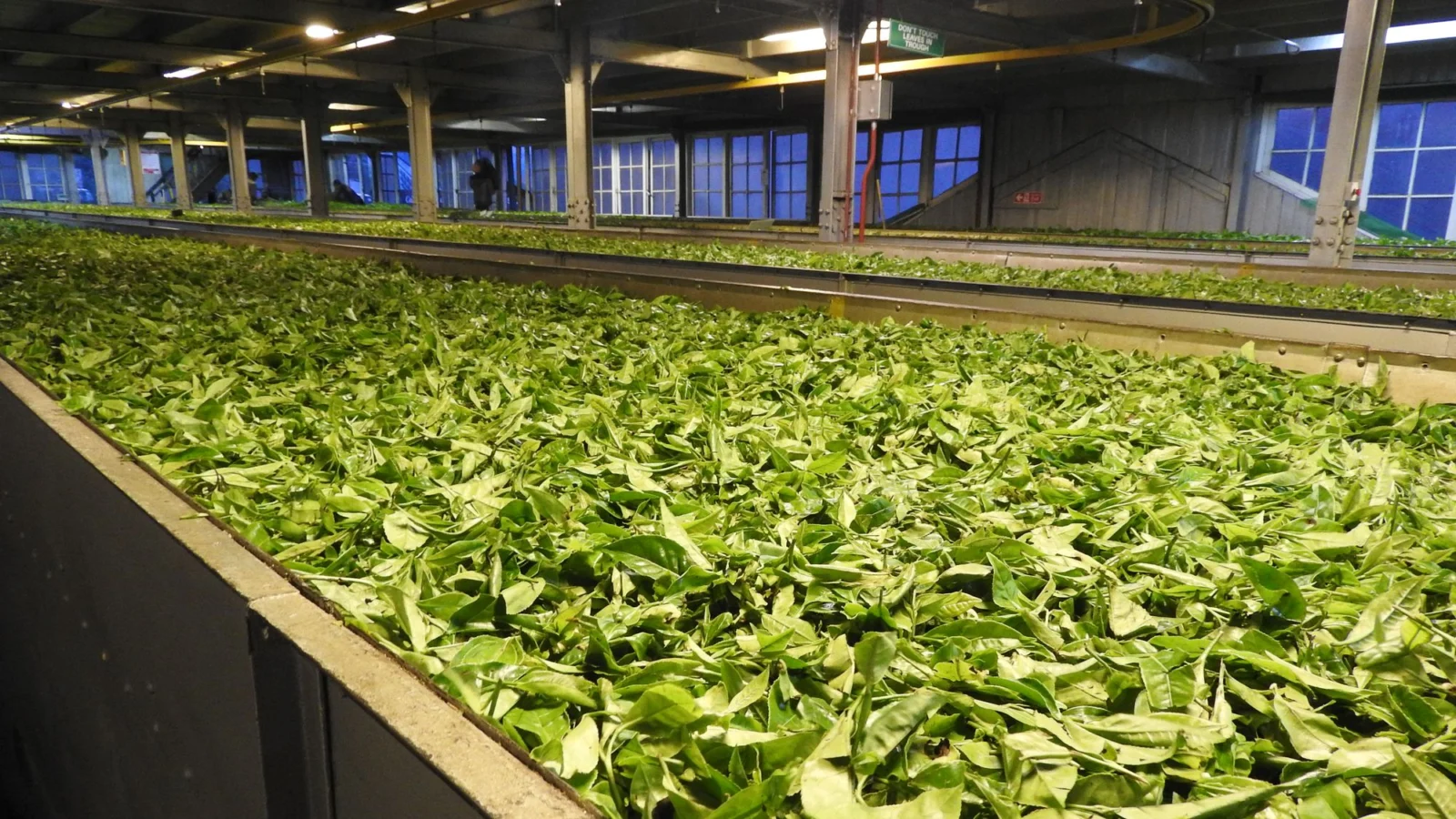
Freshly plucked leaf is far too wet and brittle to roll without shattering into dust, so the first job is withering: the leaf is spread in long troughs while air, sometimes ambient, sometimes gently warmed, is drawn or blown through it for many hours. Over that time the leaf loses roughly a third or more of its original moisture and becomes soft and pliable. This isn’t just physical drying either; biochemical changes begin here too, as proteins in the leaf start breaking down into amino acids and cell walls begin to weaken, both of which matter for what happens in the next stage.
2. Rolling: breaking the cells open
Once properly withered, the leaf goes into rolling machines, or in some operations is twisted by hand, which macerate it and rupture its cell walls. This is the critical step that lets the leaf’s natural enzymes meet its own polyphenols and oxygen in the air for the first time, kicking off the chemical reaction that will ultimately define the tea’s colour and character. How tightly, and for how long, the leaf is rolled also helps determine its eventual particle size and grade: a gentler roll on carefully handled whole leaf tends to preserve larger, more intact pieces, while a more vigorous process produces smaller, broken particles.

3. Oxidation: where colour and flavour are really made
The rolled leaf is spread out in a cool, humid room to rest and oxidise, often for one to three hours depending on conditions and the character the factory is aiming for. This is where most of a black tea’s defining chemistry actually happens. Enzymes released during rolling convert catechins, naturally present compounds in the leaf, into theaflavins first, bright, reddish compounds that develop early, and then into thearubigins, darker, more complex compounds that continue accumulating the longer oxidation runs. Theaflavins are strongly associated with brightness and briskness in the finished tea; thearubigins contribute body, depth and a rounder, maltier character. The leaf’s grassy, raw smell gives way during this stage to richer, fruitier, sometimes malty aromas, and an experienced tea maker judges the right moment to stop oxidation almost entirely by sight and smell, since go too far and the tea turns flat; stop too early and it stays thin and under-developed.
How colour-forming compounds build during oxidation
A simplified illustration of two compound families accumulating as oxidation proceeds. Theaflavins form quickly and plateau; thearubigins keep building the longer oxidation continues, until firing locks the balance in place.
Simplified for a general audience, based on peer-reviewed black tea oxidation chemistry (Aaqil et al., 2023, Foods; general tea processing literature).
4. Firing: locking the character in place
Once the oxidation has reached the point the tea maker is aiming for, the leaf passes through hot-air driers, which do two jobs at once: they stop the oxidation enzymes dead by denaturing them with heat, locking in whatever balance of theaflavins and thearubigins has developed so far, and they dry the leaf down to a stable moisture content, typically 2 to 4 percent, low enough that the tea can be stored for many months without spoiling. The leaf darkens further during this stage to the familiar black colour, and a secondary chemical process, the Maillard reaction between amino acids and residual sugars, which is the same basic reaction that browns bread crust or seared meat, adds further depth to both the tea’s colour and its flavour.
5. Sorting: separating by particle size
The fired, now genuinely black tea is passed through a series of mesh sieves that separate it by particle size into the grades covered in our companion article on Ceylon tea grades: whole leaf grades like OP and Pekoe, broken grades like BOP, and fine fannings and dust. Every single grade produced in a run is tasted before it leaves the factory floor, which is the final quality check standing between the leaf and the market.
| Stage | What happens | Typical duration |
|---|---|---|
| Withering | Moisture reduced; leaf softens and becomes pliable | 10-18 hours |
| Rolling | Cell walls ruptured; oxidation begins | 20-60 minutes |
| Oxidation | Theaflavins and thearubigins develop; colour and aroma form | 1-3 hours |
| Firing | Enzymes deactivated by heat; leaf dried and darkened | 20-30 minutes |
| Sorting | Leaf separated by particle size into trade grades | Ongoing, as batches finish |
Orthodox versus CTC: two different manufacturing philosophies
Everything described above is orthodox manufacture, the traditional method that handles leaf gently through each stage to preserve as much individual character as possible, and it’s what the overwhelming majority of Sri Lankan tea, especially the island’s prized high-grown tea, is made by. A different method called CTC, short for crush, tear, curl, uses rotating mechanical cutters to shred withered leaf into small, uniform granules in essentially one aggressive step rather than a careful graduated roll. CTC tea oxidises and brews extremely fast and is widely used for mass-market tea bags, particularly from origins such as Kenya and large parts of India, but Sri Lanka produces comparatively little of it, favouring instead the slower, more skill-dependent orthodox process that gives Ceylon tea its reputation for complexity and character.
The role of the factory manager
Behind these five stages sits a single person, usually called the factory superintendent or manager, whose judgement actually ties the whole process together on any given day. Withering time depends on the weather and the moisture content of that day’s leaf, not a fixed clock. The exact point to stop oxidation is a sensory call made by smell and sight, not a timer alone, since leaf from a drier week behaves differently from leaf plucked after heavy rain. A good manager is essentially tasting and adjusting constantly throughout the day, treating each day’s batch of leaf as its own slightly different problem to solve, rather than running a fixed, identical routine regardless of what’s actually coming off the fields that morning.
Why the factory has to be close to the fields
One detail that’s easy to overlook: freshly plucked tea leaf begins to deteriorate quickly once it’s off the bush, so factories are built close to the estates and smallholdings supplying them, and leaf is typically processed within hours of being picked rather than stored or transported long distances first. This is a large part of why Sri Lanka’s hill country is dotted with so many individual tea factories rather than a handful of large centralised processing plants; freshness genuinely depends on the leaf reaching a factory floor quickly, and that logistical constraint has shaped the physical geography of the whole industry.
- 5stages: wither, roll, oxidise, fire, sort
- ~24 hrsroughly the total time from fresh leaf to finished tea
- 2-4%final moisture content after firing
What the factory floor actually looks and sounds like
A working tea factory is a surprisingly sensory place to walk through: the sweet, grassy smell of fresh leaf in the withering lofts gives way, a floor or two along, to the warmer, fruitier smell of oxidising leaf resting in its troughs, and finally to the toasted, slightly smoky aroma near the firing driers. The rolling room has its own low, steady mechanical hum, distinct from the quieter rustle of leaf being turned by hand in the withering area. Experienced staff often say they can tell roughly which stage of production is happening on a given floor with their eyes closed, just from the smell and sound alone, which says something about how distinctly different each of these stages really is from the others, even though they all happen within the same building, on the same leaf, within the same day.
A note on tasting at the end of the line
Even after sorting, nothing leaves a reputable factory without being tasted first, a final check that connects the physical processing described above with the sensory judgement covered in our companion piece on professional tea tasting. A taster brews a sample of each grade produced that day under strict, standardised conditions and judges its appearance, aroma and taste, catching anything that slipped through, perhaps a batch that oxidised slightly too far, or leaf that dried a touch unevenly, before it’s packed, catalogued and sent on toward a buyer or auction. In a very real sense, the factory’s work and the taster’s work are two halves of the same quality system, one physical and one sensory, each checking the other.
What can go wrong at each stage, and why it matters
Each stage has its own characteristic failure mode, and understanding them helps explain why skilled, attentive factory work matters so much to the finished cup. Under-withered leaf is too wet to roll properly and tends to shred and bruise unevenly rather than twist cleanly, producing a patchy, inconsistent batch. Over-oxidised leaf turns dull and loses the brightness that comes from theaflavins, producing a flatter, less lively tea even though it may look perfectly dark and finished. Under-fired leaf retains too much moisture and will stale and spoil far faster in storage than properly dried tea. None of these mistakes are usually catastrophic on their own, but a factory that consistently manages all five stages well, batch after batch, is what separates a tea with a genuine, reliable reputation from one that varies unpredictably.
The next time you brew a cup, it’s worth remembering that what’s in front of you passed through real human judgement at nearly every one of these stages: how long to wither, how hard to roll, exactly when to stop oxidation, how long to fire. None of it happens on a fixed, unthinking schedule. It’s a craft practised fresh every single day, on every batch, by people reading the leaf in front of them.