
In the middle of the nineteenth century, Ceylon was one of the world’s genuinely significant coffee producers, not a minor player but a serious one. The hills around Kandy were covered in coffee bushes, estates multiplied through the 1840s and 1850s, and real fortunes were made and lost on the harvest. Almost none of that industry survives today, and the reason is a story worth telling properly: a tiny, specific fungus, arriving at almost exactly the moment an alternative crop happened to be ready.
A disease with a name: Hemileia vastatrix
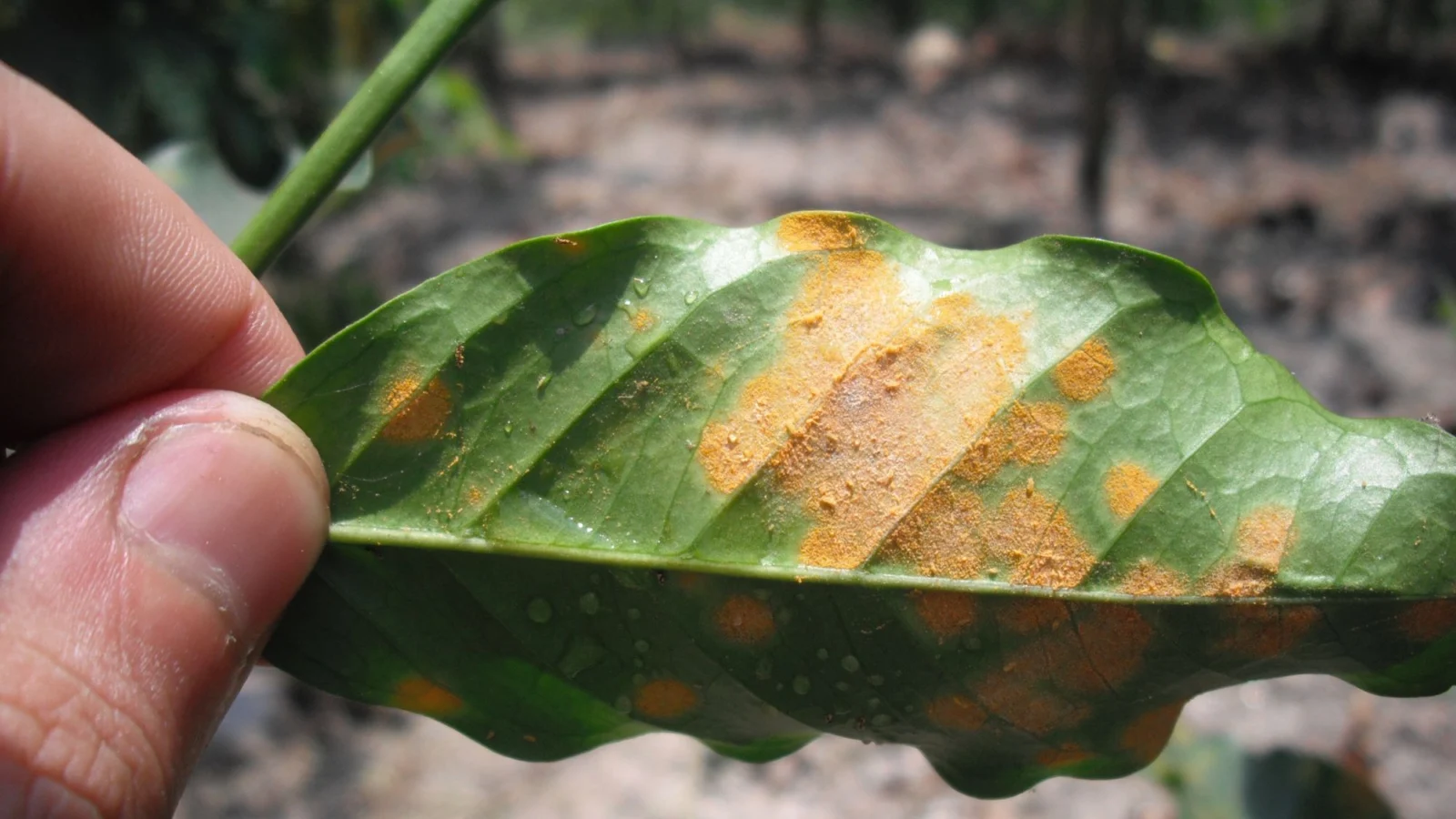
Around 1869, planters began noticing small orange, powdery spots on the undersides of coffee leaves. This was coffee leaf rust, caused by the fungus Hemileia vastatrix, which produces its distinctive orange spore pustules specifically on leaf undersides and spreads via these airborne spores from plant to plant and estate to estate. The fungus doesn’t kill a coffee bush outright or quickly; instead, it progressively weakens it, reducing the leaf area available for photosynthesis until the plant simply can no longer support a worthwhile crop. There was no effective treatment available to planters at the time, and once established in a region, the disease proved essentially impossible to eliminate with the tools available in the 1870s.
The fungus itself is believed to have originated in East Africa, around the Lake Victoria region, where it was first formally documented on wild, uncultivated coffee in 1861 by a British explorer, several years before it was reported on cultivated coffee in Ceylon in 1867. Once established on the island’s coffee estates, Ceylon became the historical epicentre of the disease’s global spread: researchers who have traced the rust’s international expansion describe an epidemic that moved out from Ceylon to eventually reach coffee-growing regions across Asia and Africa over the following decades, before crossing the Atlantic and reaching Brazil, the Western Hemisphere’s first confirmed outbreak, by around 1970. In other words, the disaster that reshaped Ceylon’s economy in the 1870s and 1880s was, on a longer timescale, just the opening chapter of a disease that would eventually touch coffee-growing regions across much of the tropical world.
The economic collapse, in broad strokes
The decline wasn’t instantaneous, but it was fast by the standards of a major agricultural economy. Through the 1870s and into the 1880s, coffee yields fell steadily and unevenly across the island as the rust spread, estate by estate and district by district, and many planters who had invested heavily in coffee infrastructure, processing buildings, roads, labour arrangements, found themselves holding assets built around a crop that could no longer reliably produce. Some simply left the industry; others, more consequentially for the island’s future, began looking seriously at alternatives.
Tea wasn’t the only alternative tried
It’s worth being honest that tea wasn’t planters’ only response to the crisis, and it wasn’t even the first one many of them reached for. Historical accounts of this period note that Ceylon planters also experimented with cacao and cinchona, the source of quinine, among other possible replacement crops, as the coffee rust crisis deepened through the 1870s. Cinchona in particular enjoyed a brief boom of its own before a separate pest problem undercut it as well, and neither crop came close to replacing coffee’s lost acreage or income at the scale tea eventually did. Tea succeeded where these other candidates didn’t, not simply because it was tried, but because it combined a already-proven track record at Loolecondera with a genuine, structural escape from the specific disease that had caused the crisis in the first place.
Coffee’s decline, in illustrative terms
A simplified, illustrative picture of coffee’s retreat and tea’s rise across the hill country through the late 19th century. Exact historical production figures from this period are harder to verify precisely than modern statistics, so treat this as a general illustration of the trend rather than precise historical data.
General historical accounts of the Ceylon coffee-to-tea transition (multiple cross-referenced sources, incl. JIRCAS Tropical Agriculture Research Series; Wikipedia ‘Tea production in Sri Lanka’).
Why tea, specifically, succeeded where coffee failed
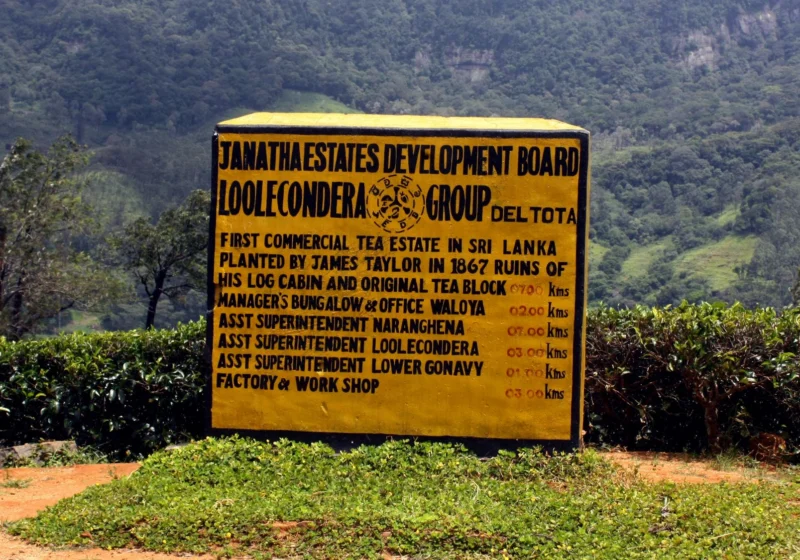
Timing mattered enormously here. James Taylor had already demonstrated, starting in 1867 at Loolecondera, that tea grew well in exactly the same hill-country conditions coffee had occupied, and had been quietly refining both cultivation and basic processing methods for several years by the time coffee’s crisis became undeniable through the 1870s. This meant that when planters needed a genuine, proven alternative rather than another speculative gamble, one already existed, with a track record, rather than needing to be invented from scratch under economic pressure. Tea also had a structural advantage over coffee in this specific crisis: Camellia sinensis is not susceptible to Hemileia vastatrix, so switching crops meant genuinely escaping the disease pressure, not just hoping a different coffee variety might fare better.
There’s a reasonable counterfactual question worth asking here: would Ceylon have become a tea island even without the coffee rust crisis? It’s impossible to answer with certainty, but the circumstantial case is strong that the two events were genuinely linked rather than coincidental. Taylor’s experimental planting at Loolecondera had been running for several years before the rust crisis fully took hold, as a modest, specialist sideline rather than a serious rival to coffee, and nothing in the historical record suggests planters were on the verge of abandoning a highly profitable coffee trade voluntarily. It was the rust, specifically, that forced the question of an alternative onto an industry that otherwise had every reason to keep doing what was already working.
| Factor | Coffee (1870s-80s) | Tea (1870s-90s) |
|---|---|---|
| Disease pressure | Severe, worsening, no effective treatment available | None from Hemileia vastatrix; different disease profile entirely |
| Proven local track record | Decades of established cultivation, now failing | A working model since 1867, actively expanding |
| Existing infrastructure | Estates, labour, roads, mostly inherited by new tea plantings | Built rapidly atop converted coffee infrastructure |
| Trajectory by century’s end | Largely abandoned as a major island crop | The island’s defining export |
A landscape that still carries the memory
Much of what makes Sri Lanka’s hill country look the way it does today, terraced hillsides, factory buildings, the specific road and settlement patterns of the plantation districts, was originally laid down during the coffee era and simply repurposed, rather than built fresh, when tea took over. Walking an old tea estate, you’re very often walking land that was first cleared and organised for coffee a generation earlier, which is part of why the two crops’ histories are so tightly, physically intertwined even though almost nobody today associates the Sri Lankan hill country with coffee at all.
A disease that still matters to tea today
Though Camellia sinensis escaped Hemileia vastatrix entirely, tea has its own major foliar disease, blister blight, caused by a different fungus, Exobasidium vexans. We cover this in a separate piece, since it remains one of the most significant ongoing challenges facing Sri Lankan tea cultivation, managed today mainly through scheduled fungicide treatment and the natural partial protection that regular plucking provides.
The human cost behind the crop switch
It’s worth pausing on what this transition actually meant for the people living through it, not just the crop statistics. Converting an estate from coffee to tea at scale, as accounts of the period describe, meant clearing dead and dying coffee bushes across well over a hundred thousand hectares of land and replanting essentially from scratch, a slow, physically demanding undertaking carried out largely by hand by estate labourers, many of them Indian-Tamil workers who had originally been brought to the island to work the coffee estates in the first place. For these communities, the coffee-to-tea transition wasn’t an abstract economic pivot read about in a planter’s ledger; it was years of hard replanting labour, with their own livelihoods tied directly to whether the new crop succeeded where the old one had failed. We cover the fuller story of the people who did this work, and who have sustained Ceylon tea ever since, in a separate piece, since it deserves more than a passing mention here.
How quickly the switch actually happened
| Period | What was happening |
|---|---|
| 1860s | Coffee dominant; Taylor’s experimental tea planting begins at Loolecondera, 1867 |
| 1869-70s | Coffee leaf rust spreads; yields begin falling across coffee estates |
| 1870s-80s | Planters experiment with cacao, cinchona and tea as replacement crops |
| Late 1880s-90s | Tea plantings scale up rapidly; coffee acreage continues shrinking |
| By c.1900 | Tea firmly established as the island’s defining export crop |
A new identity, built on an old disaster
By the close of the nineteenth century, Ceylon was known internationally not for coffee but for tea, a complete reversal of its agricultural identity within roughly a single working lifetime. It’s a genuinely unusual case in economic history: the collapse of one major export crop, rather than simply devastating an economy, directly gave rise to the industry and reputation the island is still best known for today. Every cup of Ceylon tea, including every cup of Udarata, exists in some sense because a fungus wiped out coffee at precisely the moment an alternative happened to be ready, a reminder that the hill country’s modern identity was never inevitable, but was shaped by a specific, traceable sequence of disease, timing and replanting labour.